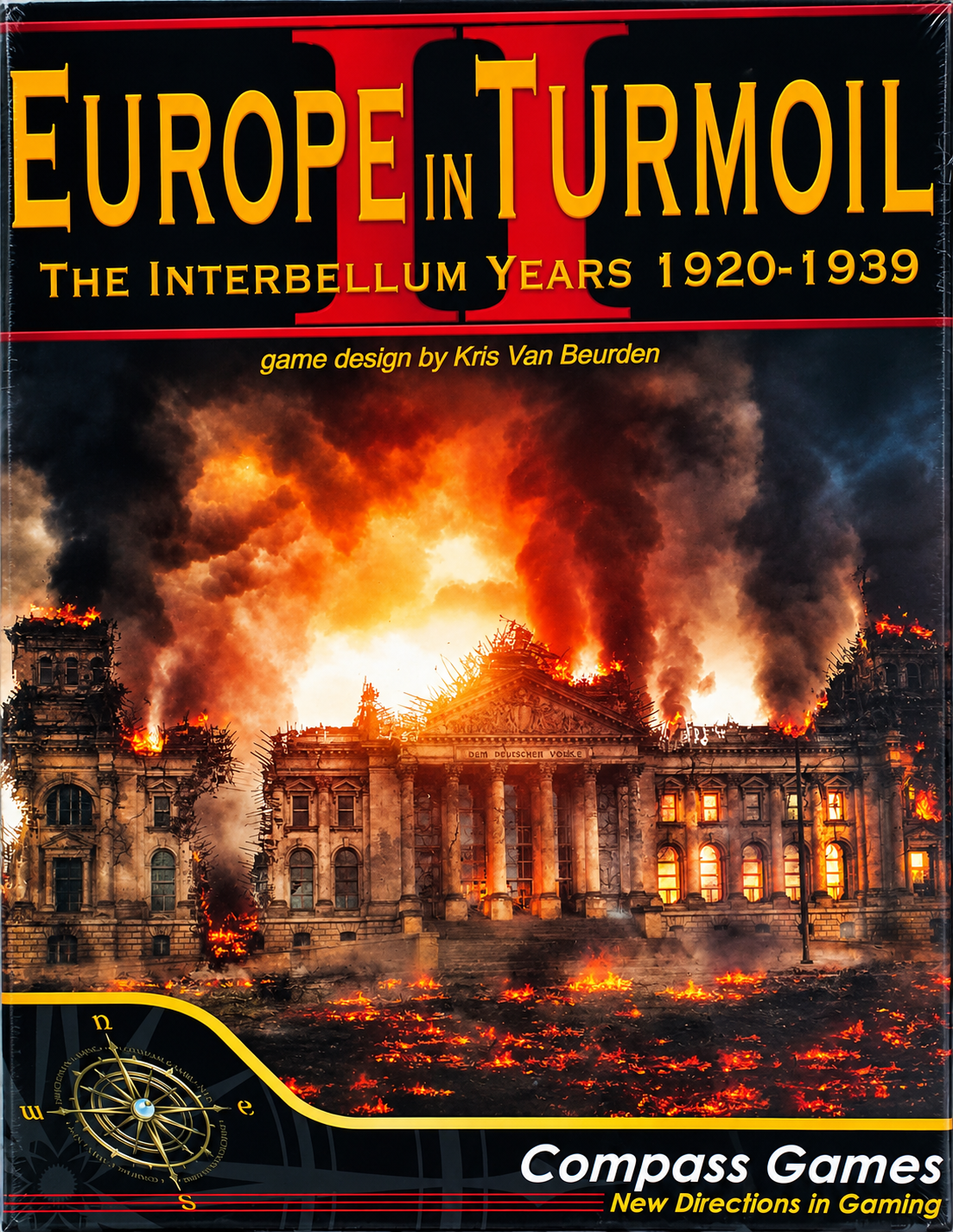
 Image 1 of 2
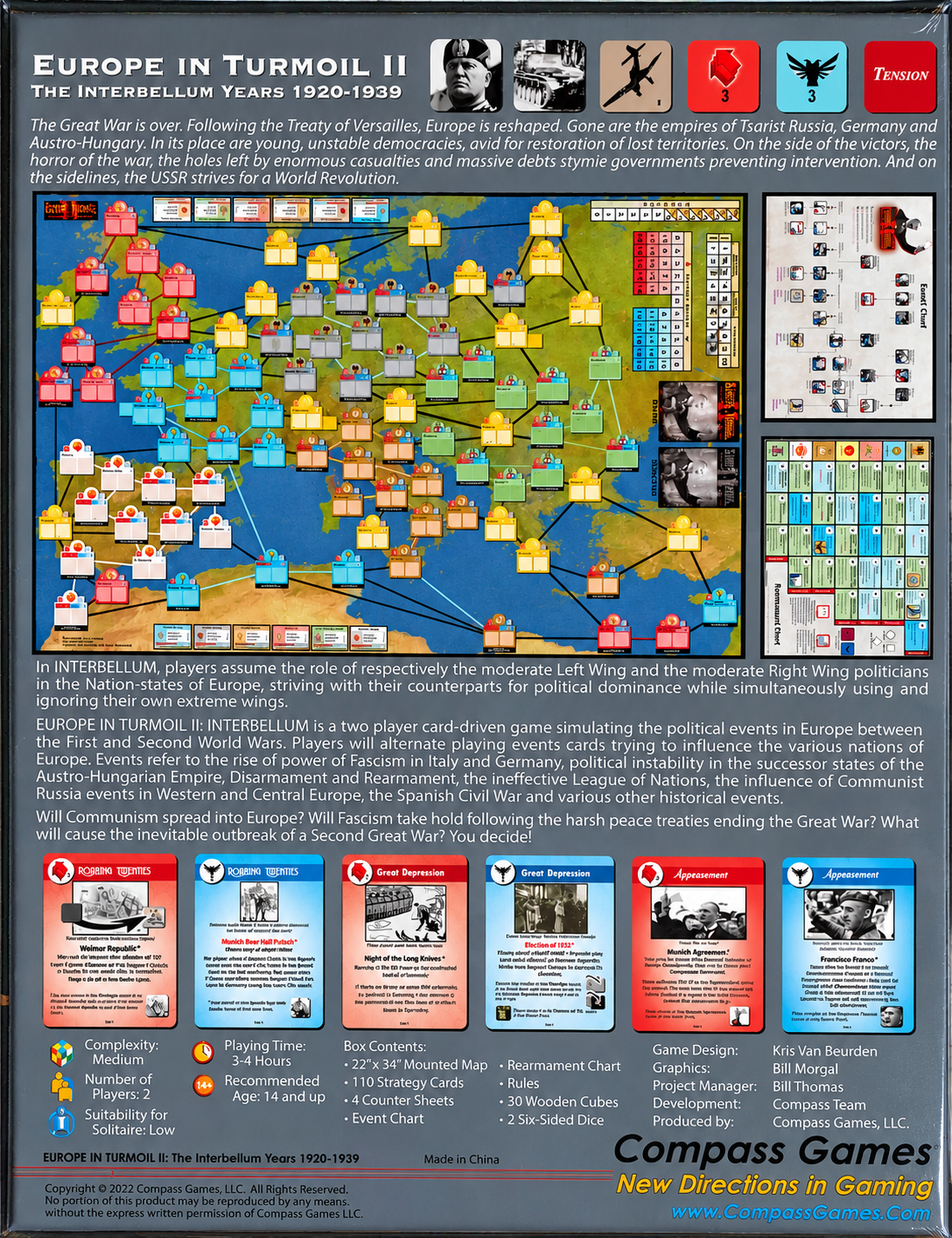 Image 2 of 2
Europe in Turmoil II: The Interbellum Years, 1920–1939 is a two-player, card-driven political strategy game exploring the turbulent years between the First and Second World Wars. Players take on the roles of moderate Left Wing and Right Wing political movements, competing for influence across Europe as economic crises, political instability and growing extremism threaten the fragile peace established after 1918.
The First World War has ended, the Treaty of Versailles has redrawn Europe's borders, and the old empires of Tsarist Russia, Germany and Austria-Hungary have collapsed. New democracies have emerged, but many face territorial disputes, economic difficulties and political divisions. Meanwhile, the victorious powers are burdened by war debts and heavy losses, limiting their willingness to intervene in European affairs.
For a time, the prosperity of the Roaring Twenties and the establishment of the League of Nations offer hope for lasting peace. However, unresolved tensions remain beneath the surface. The Wall Street Crash of 1929 and the resulting Great Depression create conditions in which nationalism, political extremism and competing ideologies gain increasing support.
As Europe moves towards another major conflict, players must navigate shifting political loyalties, influence national governments and respond to historical events that could change the continent's future.
This game includes:
1 Mounted 22" × 34" Game Map
4 Counter Sheets
110 Strategy Cards
1 Event Chart
1 Rearmament Chart
2 Player Aids
30 Wooden Cubes (15 Blue and 15 Red)
1 Rules Booklet
2 Six-Sided Dice
Key Features:
Two-player card-driven political strategy game covering Europe from 1920 to 1939
Compete for political dominance as moderate Left Wing and Right Wing movements
Historical events influence the political direction of European nations
Explore the rise of Fascism and Communism during the interwar period
Economic instability, nationalism and political extremism shape the struggle for influence
Includes the Great Depression, disarmament, rearmament and the League of Nations
Political instability in the successor states of the Austro-Hungarian Empire
Soviet influence and the competing ambitions of Communist factions
Historical events surrounding the Spanish Civil War
Strategic card play creates opportunities to influence nations and challenge opposing political movements
Multiple possible political developments and outcomes provide replayability
About the Game:
Europe in Turmoil II places players in the middle of Europe's political struggles during the two decades separating the World Wars. Rather than commanding armies on the battlefield, players compete to shape the political landscape of the continent through influence, events and strategic decisions.
One player represents moderate Left Wing politicians, while the other takes control of the moderate Right Wing. Both seek to establish political dominance within Europe's nation-states, but must also contend with the more extreme factions associated with their respective political movements.
The game uses a card-driven system in which players alternate playing strategy cards to influence events and political developments across the map. Choosing when and where to act is important, as political circumstances can change rapidly and opportunities may disappear as new events unfold.
Historical developments form an important part of the experience. Players encounter the rise of Fascism in Italy and Germany, political uncertainty in the countries formed after the collapse of Austria-Hungary, and the growing influence of Communist Russia across Central and Western Europe.
The game also examines the failure of international diplomacy to prevent renewed conflict. The League of Nations struggles to maintain stability, while disarmament agreements, military rearmament and changing national priorities add further complications to an already divided continent.
A Continent Divided by Politics
The political situation in Europe becomes increasingly difficult as the years progress. The economic optimism of the 1920s gives way to the hardships of the Great Depression, creating opportunities for radical movements to gain support.
Within the Soviet Union, competing Communist factions disagree over whether to consolidate the revolution at home or encourage its spread beyond Soviet borders. Across Europe, nationalist movements seek to overturn the territorial settlements imposed after the First World War.
Players must decide how to respond to these developments while pursuing their own political objectives. Supporting particular movements may strengthen their position in one country but create difficulties elsewhere.
The Spanish Civil War, changing military policies and the growing tensions between European powers all contribute to the uncertainty surrounding the continent's future.
The challenge lies in balancing political influence with the unpredictable effects of historical events. Players must consider both their immediate opportunities and the longer-term consequences of their decisions.
The Road to Another World War
As the game approaches the end of the 1930s, the political divisions that emerged after the Great War become increasingly difficult to contain.
Will Communist influence spread further across Europe? Can moderate political movements retain control, or will extremist factions gain the upper hand? Could different political decisions alter the circumstances leading to the outbreak of the Second World War?
Europe in Turmoil II allows players to explore these questions through a combination of historical events and alternative political developments.
With its emphasis on card management, political influence and competing ideologies, the game offers a different perspective on European history, focusing on the diplomatic and political struggles that shaped the interwar years rather than conventional military operations.
Game Details:
Players: 2
Playing Time: 3–4 Hours
Complexity: Medium (5/10)
Solitaire Suitability: Low
Time Scale: 2 Years per Turn
Historical Period: 1920–1939
Game Type: Card-Driven Political Strategy
Recommended Age: 14+
Europe in Turmoil II: The Interbellum Years, 1920–1939 offers a detailed examination of the political tensions that shaped Europe between the World Wars. Through historical events, competing ideologies and strategic card play, players can explore how different political choices might have influenced the continent's path towards the Second World War.