 Image 1 of 2
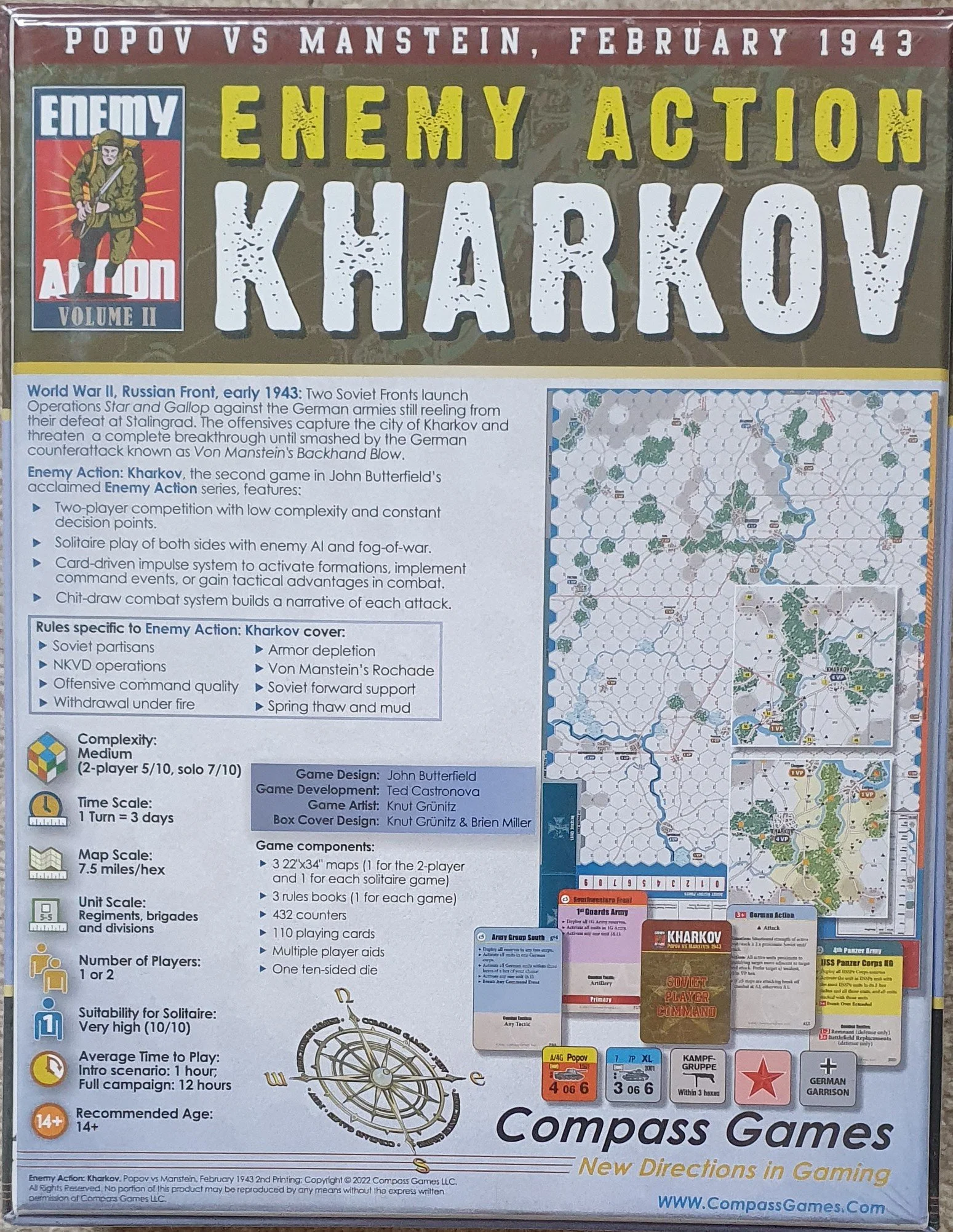 Image 2 of 2
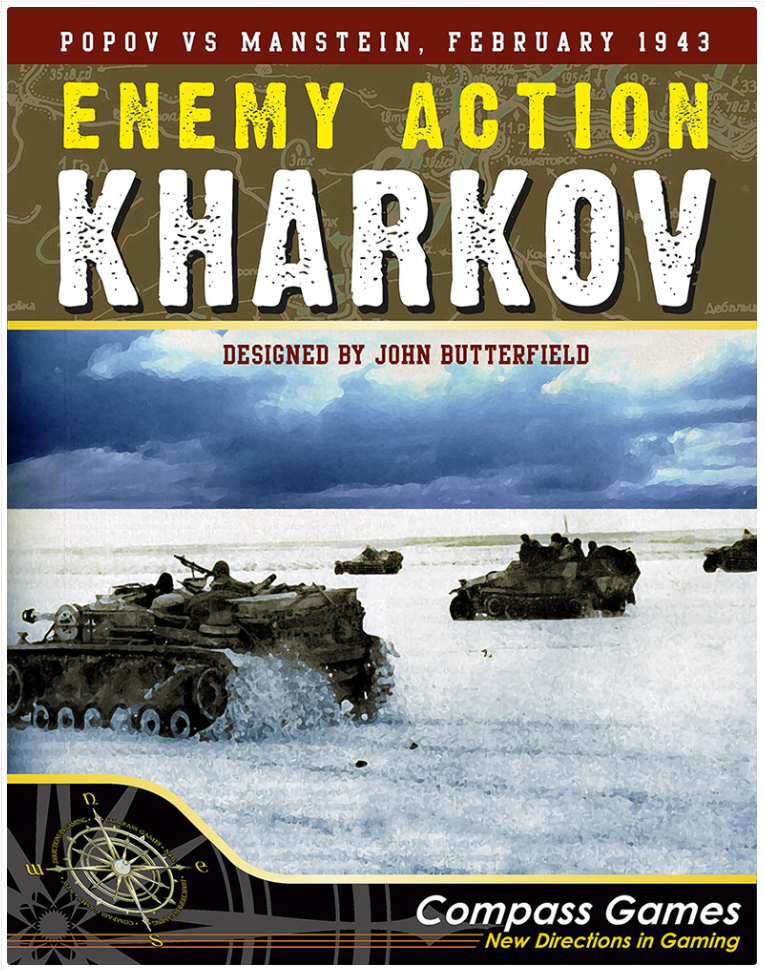
Enemy Action: Kharkov is the second game in John Butterfield’s acclaimed Enemy Action series, bringing the dramatic Third Battle of Kharkov to the tabletop. Designed for either one or two players, it combines a card-driven operational system with dedicated solitaire games that allow you to command either the Soviet or German forces.
Early 1943. Following the German defeat at Stalingrad, two Soviet Fronts launch Operations Star and Gallop against German forces still reeling from their recent losses. The Soviet offensives capture Kharkov and threaten a major breakthrough, but the advance is soon met by the German counterstroke that became known as Von Manstein’s Backhand Blow.
Enemy Action: Kharkov places you in command during this critical period on the Eastern Front, where operational timing, command decisions, manoeuvre, and the ability to exploit opportunities can determine the outcome.
The game uses the established Enemy Action card-driven impulse system. Multi-purpose cards can be used to activate formations, trigger command events, or secure tactical advantages during combat. Rather than relying on conventional combat charts, attacks are resolved by drawing combat chits, creating an unfolding sequence of results that gives each engagement its own narrative.
For solitaire players, the system goes considerably further than simply adapting the two-player rules. Dedicated solitaire games allow you to play either side while the game controls the opposing army’s command decisions and tactics. Fog of war adds further uncertainty, with enemy formations sometimes remaining hidden until your forces make contact. Units behind the front can also disappear and later reappear elsewhere within realistic movement restrictions, making the opposing army much harder to predict.
Recreates the Third Battle of Kharkov in early 1943
Second title in John Butterfield’s Enemy Action series
Play competitively with two players or solitaire as either side
Dedicated enemy AI and fog-of-war systems for solitaire play
Card-driven impulse system with multi-purpose command cards
Combat chit system creates a developing narrative for each engagement
Soviet partisan operations
NKVD operations
Offensive command quality rules
Withdrawal under fire
Armour depletion
Von Manstein’s Rochade rapid redeployment
Soviet forward support
Spring thaw and mud conditions
Low counter density with frequent operational decisions
Players: 1–2
Complexity: Medium — 5/10 for two-player play; 7/10 for solitaire
Solitaire Suitability: Very High — 10/10
Playing Time: Approximately 1 hour for the introductory scenario; around 12 hours for the full campaign
Time Scale: 1 Turn = 3 Days
Map Scale: 7.5 Miles per Hex
Unit Scale: Regiments, Brigades and Divisions
Recommended Age: 14+
Three 22" × 34" Maps — one for the two-player game and one for each solitaire game
Three Rulebooks — one for each game
432 Counters
110 Playing Cards
Multiple Player Aid Cards
One 10-Sided Die
The Soviet armies have the momentum, but their rapid advance has left them exposed. German forces are preparing a powerful counterattack that could reverse the situation across the entire sector. Whether commanding the advancing Soviets, orchestrating Manstein’s counterstroke, or taking on the game's solitaire system, Enemy Action: Kharkov delivers an operational contest built around uncertainty, manoeuvre, and difficult command decisions.
Enemy Action: Kharkov is the second game in John Butterfield’s acclaimed Enemy Action series, bringing the dramatic Third Battle of Kharkov to the tabletop. Designed for either one or two players, it combines a card-driven operational system with dedicated solitaire games that allow you to command either the Soviet or German forces.
Early 1943. Following the German defeat at Stalingrad, two Soviet Fronts launch Operations Star and Gallop against German forces still reeling from their recent losses. The Soviet offensives capture Kharkov and threaten a major breakthrough, but the advance is soon met by the German counterstroke that became known as Von Manstein’s Backhand Blow.
Enemy Action: Kharkov places you in command during this critical period on the Eastern Front, where operational timing, command decisions, manoeuvre, and the ability to exploit opportunities can determine the outcome.
The game uses the established Enemy Action card-driven impulse system. Multi-purpose cards can be used to activate formations, trigger command events, or secure tactical advantages during combat. Rather than relying on conventional combat charts, attacks are resolved by drawing combat chits, creating an unfolding sequence of results that gives each engagement its own narrative.
For solitaire players, the system goes considerably further than simply adapting the two-player rules. Dedicated solitaire games allow you to play either side while the game controls the opposing army’s command decisions and tactics. Fog of war adds further uncertainty, with enemy formations sometimes remaining hidden until your forces make contact. Units behind the front can also disappear and later reappear elsewhere within realistic movement restrictions, making the opposing army much harder to predict.
Recreates the Third Battle of Kharkov in early 1943
Second title in John Butterfield’s Enemy Action series
Play competitively with two players or solitaire as either side
Dedicated enemy AI and fog-of-war systems for solitaire play
Card-driven impulse system with multi-purpose command cards
Combat chit system creates a developing narrative for each engagement
Soviet partisan operations
NKVD operations
Offensive command quality rules
Withdrawal under fire
Armour depletion
Von Manstein’s Rochade rapid redeployment
Soviet forward support
Spring thaw and mud conditions
Low counter density with frequent operational decisions
Players: 1–2
Complexity: Medium — 5/10 for two-player play; 7/10 for solitaire
Solitaire Suitability: Very High — 10/10
Playing Time: Approximately 1 hour for the introductory scenario; around 12 hours for the full campaign
Time Scale: 1 Turn = 3 Days
Map Scale: 7.5 Miles per Hex
Unit Scale: Regiments, Brigades and Divisions
Recommended Age: 14+
Three 22" × 34" Maps — one for the two-player game and one for each solitaire game
Three Rulebooks — one for each game
432 Counters
110 Playing Cards
Multiple Player Aid Cards
One 10-Sided Die
The Soviet armies have the momentum, but their rapid advance has left them exposed. German forces are preparing a powerful counterattack that could reverse the situation across the entire sector. Whether commanding the advancing Soviets, orchestrating Manstein’s counterstroke, or taking on the game's solitaire system, Enemy Action: Kharkov delivers an operational contest built around uncertainty, manoeuvre, and difficult command decisions.