 Image 1 of 1
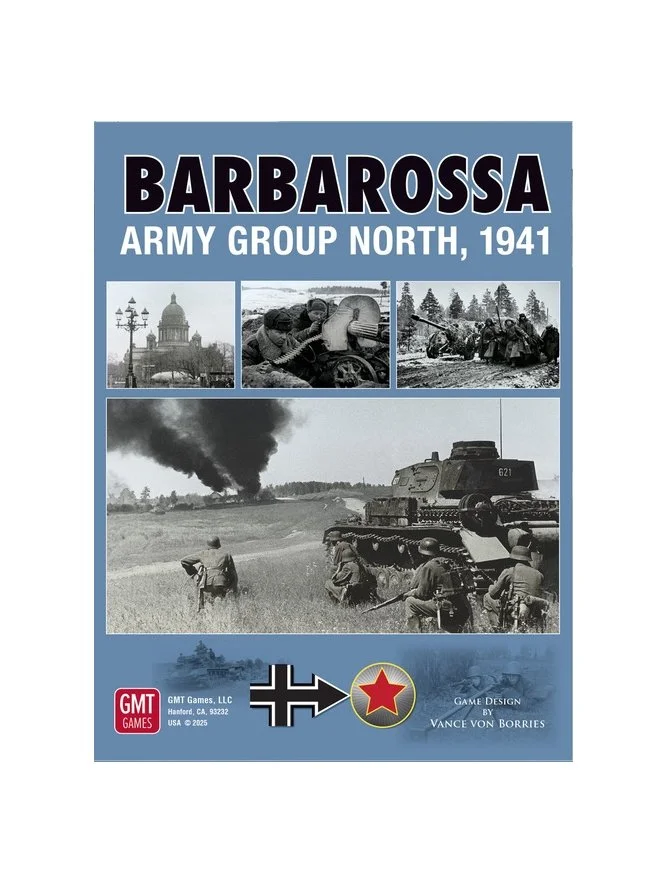
Barbarossa: Army Group North, 1941 (2nd Edition) is a detailed operational wargame that recreates the German advance toward Leningrad during the opening phase of Operation Barbarossa. Players take command of either Axis or Soviet forces, managing large-scale operations across the Baltic region in a campaign defined by mobility, logistics, and defensive resilience.
This second edition refines and expands the original system, offering enhanced rules, updated components, and multiple scenarios to suit different levels of experience.
This game includes:
Five full-colour 22" x 34" mapsheets
Two additional 17" x 22" mapsheets (double-sided)
Approximately 980 die-cut counters
Rulebook (36 pages)
Playbook (48 pages)
Multiple player aid and setup cards
Game charts and reference materials
One ten-sided die
Box and lid set
Key features:
Operational-level Eastern Front gameplay
Command Axis or Soviet forces in a historically grounded campaign
Multiple scenarios, from introductory to full campaign
Asymmetrical gameplay reflecting strengths and limitations of each side
Integrated air, weather, and logistics systems
Detailed order of battle including specialised units
About the game:
Set during the summer and autumn of 1941, the game focuses on Army Group North’s advance through the Baltic states toward Leningrad. The Axis player must push forward using speed and concentration of force, while the Soviet player relies on delaying tactics, defensive lines, and gradual reinforcement to slow the advance.
The system highlights the contrasting capabilities of both sides. Axis forces excel at rapid breakthroughs and coordinated operations, while Soviet forces must manage a more rigid command structure and respond to evolving threats across a wide front.
Terrain and infrastructure play a major role, with rivers, roads, and fortified lines shaping movement and combat decisions. Weather and supply also influence operations, requiring careful planning over the course of the campaign.
With multiple scenarios and a full campaign option, players can explore different stages of the operation or engage in a long-form strategic challenge. Each playthrough presents new decisions, reflecting the complexity and uncertainty of the historical campaign.
Game details:
Players: 1–4
Playtime: Varies by scenario (short scenarios to full campaign)
Complexity: Medium to high
Solitaire suitability: Moderate
Time scale: 2 days per turn
Map scale: 5 miles per hex
Ground unit scale: Division/Regiment
Air unit scale: 40–80 aircraft per counter
Barbarossa: Army Group North, 1941 (2nd Edition) is a detailed operational wargame that recreates the German advance toward Leningrad during the opening phase of Operation Barbarossa. Players take command of either Axis or Soviet forces, managing large-scale operations across the Baltic region in a campaign defined by mobility, logistics, and defensive resilience.
This second edition refines and expands the original system, offering enhanced rules, updated components, and multiple scenarios to suit different levels of experience.
This game includes:
Five full-colour 22" x 34" mapsheets
Two additional 17" x 22" mapsheets (double-sided)
Approximately 980 die-cut counters
Rulebook (36 pages)
Playbook (48 pages)
Multiple player aid and setup cards
Game charts and reference materials
One ten-sided die
Box and lid set
Key features:
Operational-level Eastern Front gameplay
Command Axis or Soviet forces in a historically grounded campaign
Multiple scenarios, from introductory to full campaign
Asymmetrical gameplay reflecting strengths and limitations of each side
Integrated air, weather, and logistics systems
Detailed order of battle including specialised units
About the game:
Set during the summer and autumn of 1941, the game focuses on Army Group North’s advance through the Baltic states toward Leningrad. The Axis player must push forward using speed and concentration of force, while the Soviet player relies on delaying tactics, defensive lines, and gradual reinforcement to slow the advance.
The system highlights the contrasting capabilities of both sides. Axis forces excel at rapid breakthroughs and coordinated operations, while Soviet forces must manage a more rigid command structure and respond to evolving threats across a wide front.
Terrain and infrastructure play a major role, with rivers, roads, and fortified lines shaping movement and combat decisions. Weather and supply also influence operations, requiring careful planning over the course of the campaign.
With multiple scenarios and a full campaign option, players can explore different stages of the operation or engage in a long-form strategic challenge. Each playthrough presents new decisions, reflecting the complexity and uncertainty of the historical campaign.
Game details:
Players: 1–4
Playtime: Varies by scenario (short scenarios to full campaign)
Complexity: Medium to high
Solitaire suitability: Moderate
Time scale: 2 days per turn
Map scale: 5 miles per hex
Ground unit scale: Division/Regiment
Air unit scale: 40–80 aircraft per counter