 Image 1 of 2
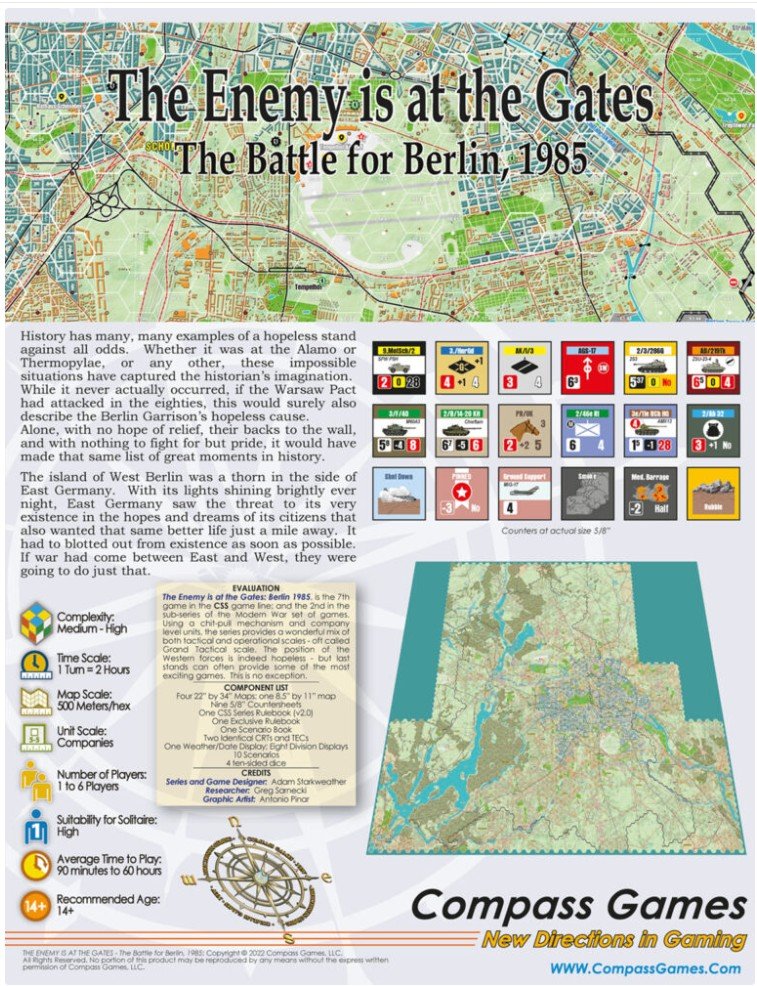 Image 2 of 2
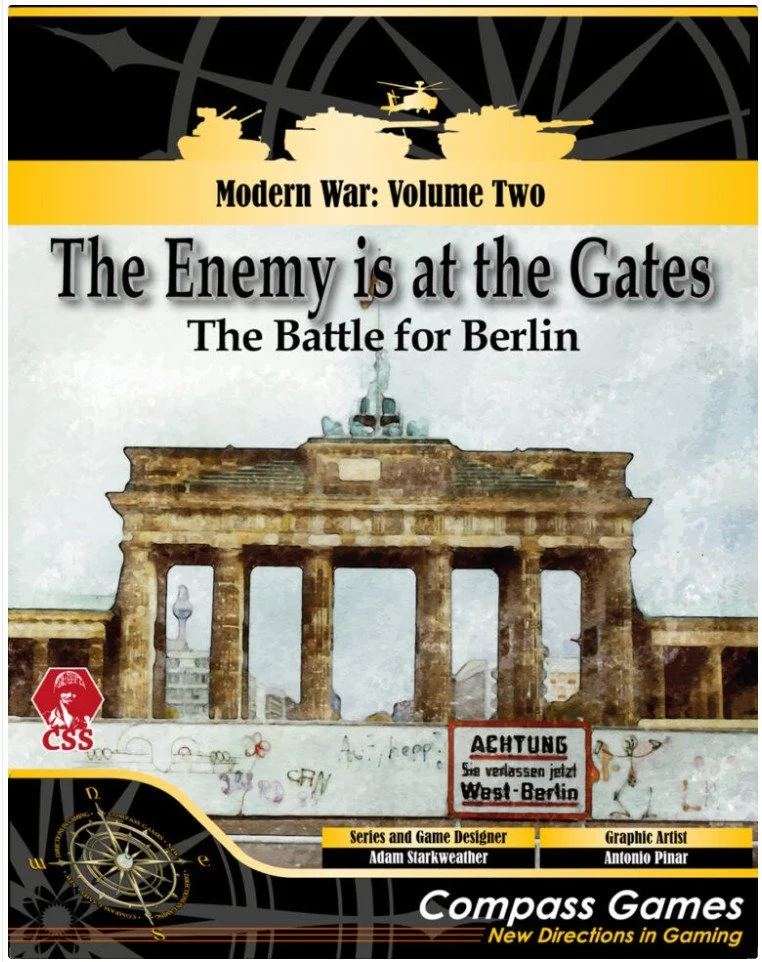
The Enemy is at the Gates: The Battle for Berlin 1985 is a hypothetical Cold War wargame exploring what might have happened if Warsaw Pact forces had launched a full-scale assault on West Berlin in August 1985. Using the Company Scale System (CSS), the game recreates a large-scale urban battle between East German and Soviet forces and the isolated NATO garrisons defending the western half of the divided city.
For decades, West Berlin stood as a symbol of Western resistance deep inside East German territory. Surrounded by Warsaw Pact forces and with no immediate prospect of reinforcement in the event of war, the city represented one of NATO's most vulnerable positions. Yet its American, British and French garrisons were well trained, heavily equipped and prepared to defend their sectors against a much larger attacking force.
In this alternative history, the Warsaw Pact offensive begins in the early hours of 1 August 1985. East German forces, supported by Soviet formations and internal security units, launch a carefully planned operation intended to capture West Berlin within three days. Airports, railway stations, military installations and other important infrastructure become immediate targets as the attackers attempt to overwhelm the defenders before organised resistance can develop.
The NATO garrisons must hold their positions against overwhelming odds, using their training, equipment and knowledge of the city to delay the attackers. With the battle unfolding across streets, parks, industrial districts and residential areas, every important junction and defensive position could influence the outcome.
This game includes:
4 Full-Colour Maps (22" × 34" Each)
1 Additional Map (8.5" × 11")
9 Countersheets with 5/8" Playing Counters
1 Company Scale System (CSS) Series Rulebook (Version 2.0)
1 Exclusive Rules Booklet
1 Scenario Book
2 Identical Combat Results Tables (CRTs) and Terrain Effects Charts (TECs)
1 Weather/Date Display
8 Division Displays
4 Ten-Sided Dice
Key Features:
Hypothetical World War III battle for West Berlin in August 1985
Part of the Company Scale System (CSS) series from Compass Games
Large-scale modern urban warfare at company-level scale
Detailed recreation of Berlin's streets, districts and surrounding terrain
East German and Soviet forces confronting American, British and French NATO garrisons
Includes regular military formations, security forces and West Berlin police units
Chit-pull activation system introducing uncertainty and changing battlefield conditions
Command and control systems influencing the coordination of military operations
Modern weapons and equipment, including tanks, infantry fighting vehicles and artillery
Air power, helicopters and electronic warfare
Chemical weapons and sabotage operations
Historical research and detailed orders of battle
Multiple scenarios covering different aspects of the assault
Suitable for both competitive and solitaire play
Variable playing times, from shorter engagements to extended operational battles
About the Game:
At the height of the Cold War, Berlin remained one of Europe's most politically sensitive and militarily exposed locations. Divided between East and West following the Second World War, the city became a focal point of confrontation between NATO and the Warsaw Pact.
West Berlin was surrounded by East Germany, leaving its Western garrisons isolated from the rest of NATO territory. In the event of a major European war, the city's defenders would have faced a difficult situation, with enemy forces positioned nearby and little prospect of immediate outside assistance.
The Enemy is at the Gates examines this possible conflict through a detailed operational wargame, beginning with a Warsaw Pact attack on 1 August 1985.
The East German leadership viewed West Berlin as both a political obstacle and a potential military threat. Plans for an assault placed considerable emphasis on speed, surprise and the rapid seizure of strategically important locations.
The attacking forces would be expected to destroy or capture key infrastructure, defeat NATO's organised military resistance and secure control of the city before the Western powers could respond.
The game's hypothetical campaign allows players to explore whether these plans could have succeeded against the well-prepared NATO garrisons.
Warsaw Pact Forces – The Assault on West Berlin
The Warsaw Pact offensive is led primarily by East German formations, supported by Soviet units stationed in and around Berlin.
The attacking forces include the 1st Motorised Rifle Division, together with specialist formations such as the Friedrich Engels Guard Regiment and Hugo Eberlein Guard Regiment.
East German paramilitary and security organisations also play a role, reflecting the political importance of the operation and the intention to establish control over the city following its capture.
Soviet support includes the 6th Separate Guards Motor Rifle Brigade, stationed in East Berlin, with the powerful 35th Motorised Rifle Division available nearby if additional forces are required.
These formations provide the Warsaw Pact with a substantial numerical advantage, including armoured vehicles, mechanised infantry, artillery and other modern military equipment.
The attackers must make effective use of their strength while overcoming the difficulties of fighting through a densely populated urban environment. Capturing major installations, maintaining momentum and coordinating different formations are essential to achieving a rapid victory.
NATO Forces – Defending an Isolated City
Opposing the Warsaw Pact are the American, British and French military formations stationed in West Berlin.
The principal NATO forces consist of three independent brigades:
United States Berlin Brigade: A well-equipped American formation prepared to defend its sector of the city.
British Berlin Infantry Brigade: British troops trained and equipped for operations in Berlin's distinctive urban environment.
Forces Françaises à Berlin: French military units forming an important part of the Allied defensive presence.
Although heavily outnumbered, these forces possess modern weapons, armoured vehicles and artillery, together with well-trained personnel familiar with their assigned defensive responsibilities.
Thousands of West Berlin police officers would also be available to support the defence. While less heavily equipped than the regular military formations, their local knowledge and determination could make them valuable during fighting within the city.
The NATO player must decide how best to deploy limited forces, protect essential positions and respond to attacks from several directions.
With little hope of reinforcement, preserving combat strength and making effective use of defensive terrain are critical to prolonging resistance.
Modern Urban Warfare on a Massive Scale
The Enemy is at the Gates uses the established Company Scale System, with most combat units representing companies and some smaller formations.
At 500 metres per hex, the game provides a detailed representation of the urban battlefield while covering a large geographical area.
The maps, created by Antonio Pinar, depict Berlin and its surroundings in considerable detail, allowing players to conduct operations across a mixture of built-up districts, roads, open spaces and other terrain.
Urban warfare presents particular challenges for both sides. Armoured formations may possess considerable firepower but can become vulnerable when operating through restricted streets or heavily defended areas.
Infantry, artillery and supporting weapons must be coordinated carefully, while the control of key routes and locations can influence the movement of reinforcements and the progress of an offensive.
The game's scale allows players to examine these challenges while retaining the wider operational perspective of the battle.
Command, Control and Modern Battlefield Systems
The Company Scale System places considerable emphasis on command and control, reflecting the difficulties of coordinating military formations during a fast-moving battle.
A chit-pull mechanism introduces uncertainty into the sequence of operations, preventing players from knowing exactly when formations will be able to act.
This creates a changing battlefield situation in which commanders must adapt their plans as opportunities arise and unexpected developments occur.
The game also incorporates several important aspects of modern warfare, including:
Air Power: Aircraft supporting ground operations and influencing the wider battlefield.
Helicopters: Rotary-wing aircraft providing additional mobility and combat capabilities.
Electronic Warfare: The disruption and protection of communications and battlefield systems.
Chemical Weapons: The potential use of chemical agents and their effects on military operations.
Sabotage: Actions intended to disrupt important installations and enemy capabilities.
Together, these systems add further challenges to the battle, requiring players to consider more than the movement and combat strength of individual formations.
Scenarios and Historical Research
The game includes 10 scenarios, allowing players to explore different aspects of the hypothetical battle for Berlin.
These range from smaller engagements to extensive operations involving numerous formations across the city.
The scenarios are supported by detailed orders of battle researched by Greg Sarnecki, reflecting the military units and equipment that could have participated in such a conflict.
The accompanying rules, displays and charts provide the information needed to manage the various formations and modern combat systems.
With its combination of carefully researched military organisations, detailed maps and alternative historical setting, The Enemy is at the Gates offers an opportunity to examine one of the Cold War's most dangerous potential flashpoints.
Game Details:
Players: 1–6
Playing Time: Approximately 90 Minutes to 60 Hours, Depending on Scenario
Complexity: Medium to High
Solitaire Suitability: High
Time Scale: 1 Turn = 2 Hours
Map Scale: 500 Metres per Hex
Unit Scale: Companies
Scenarios: 10
Historical Setting: Hypothetical Warsaw Pact Invasion of West Berlin
Campaign Start Date: 1 August 1985
Recommended Age: 14+
Game System: Company Scale System (CSS)
The Enemy is at the Gates: The Battle for Berlin 1985 offers a detailed examination of a Cold War confrontation that never took place. Combining large-scale urban combat, modern military technology and the unpredictable nature of command and control, the game challenges players to determine whether the isolated NATO garrisons could withstand a major Warsaw Pact assault or whether East German and Soviet forces could capture West Berlin as planned.