 Image 1 of 2
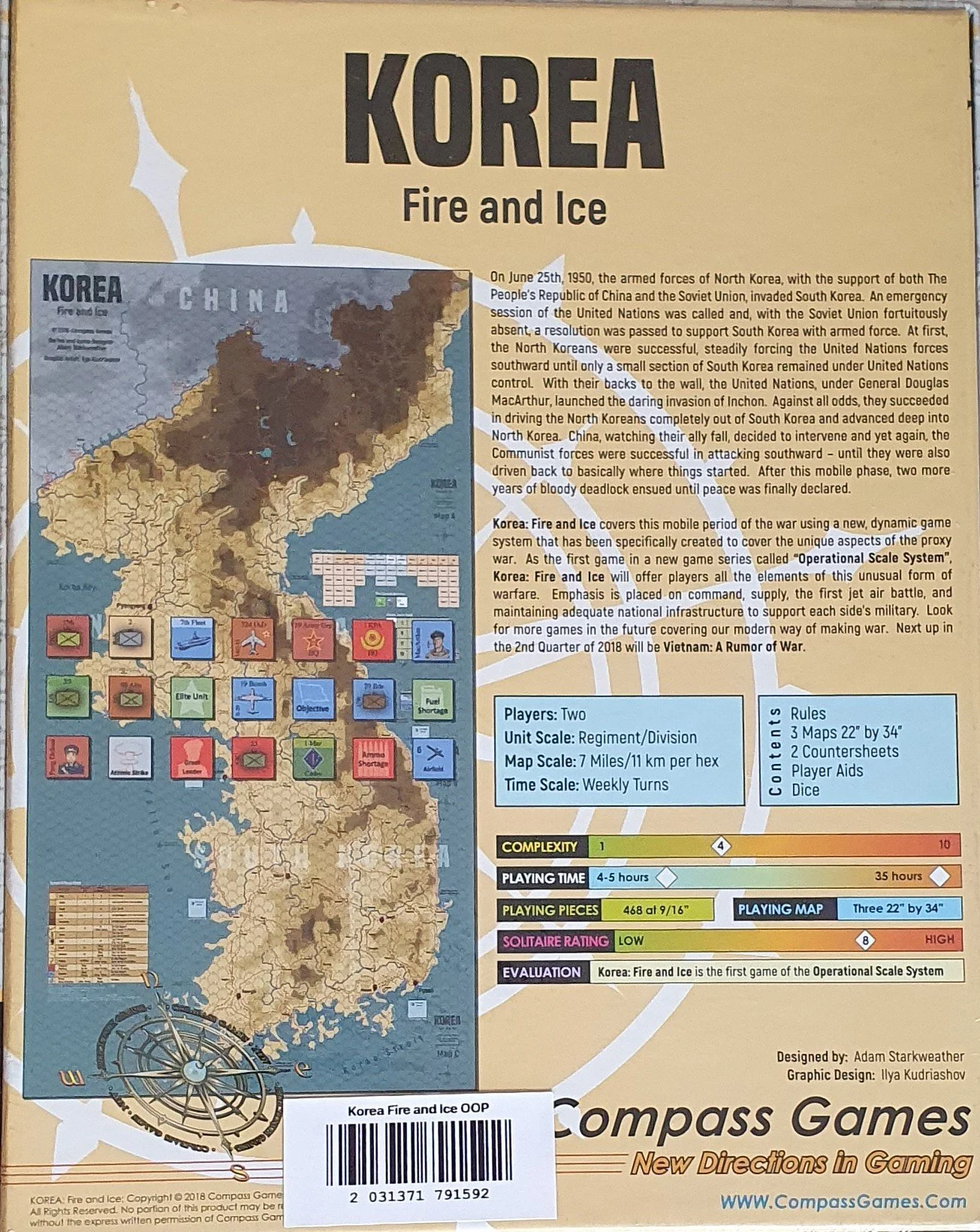 Image 2 of 2
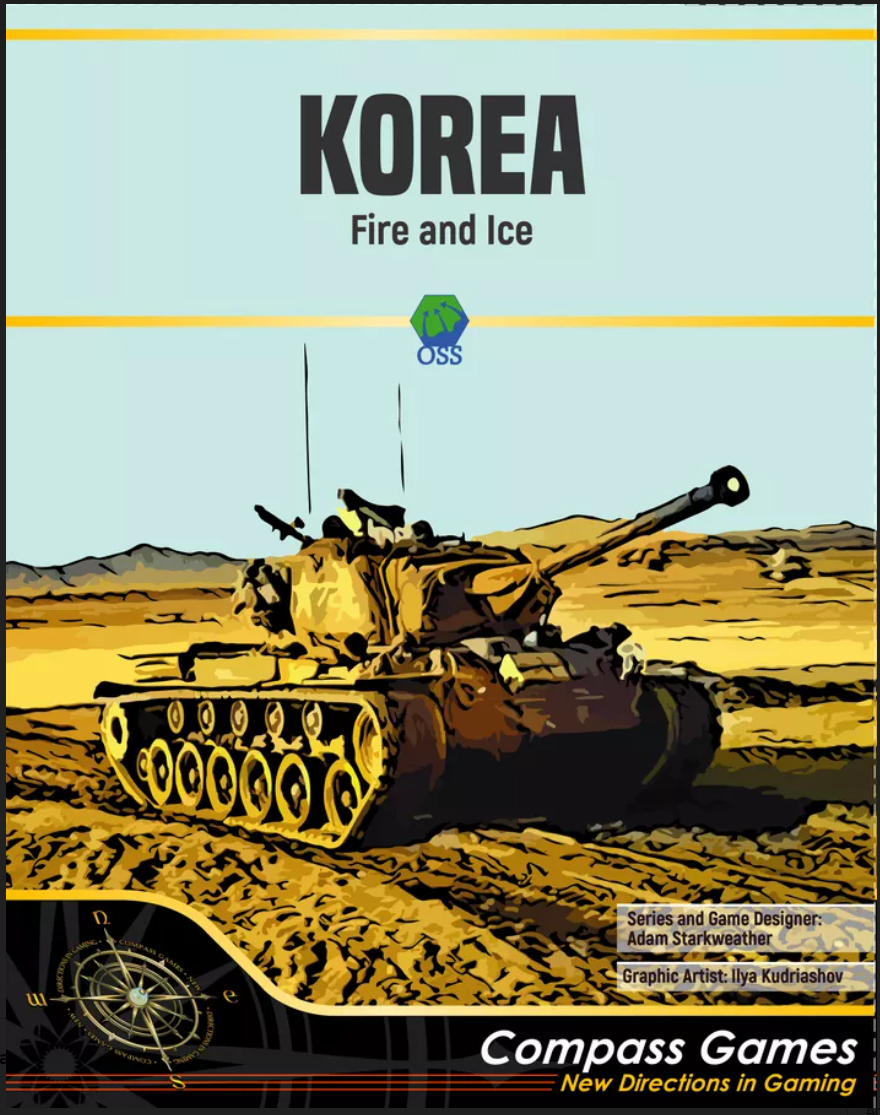
Korea: Fire and Ice (OSS) is an operational-level wargame covering the highly mobile opening period of the Korean War. Beginning with the North Korean invasion of South Korea in June 1950, the game follows the dramatic swings of the campaign as United Nations forces retreat south, counterattack at Inchon, advance deep into North Korea, and then face the intervention of Communist Chinese forces.
As the first game in Compass Games' Operational Scale System (OSS), Korea: Fire and Ice combines manoeuvre, command, supply, air power, and political considerations in a system designed to portray the distinctive character of modern operational warfare without excessive rules overhead.
This game includes:
3 Full-Colour 22" × 34" Maps
2 Counter Sheets
468 Playing Pieces (9/16" Counters)
Player Aid Cards
Rulebook
Dice
Game Box
Key Features:
First title in the Operational Scale System (OSS)
Covers the mobile phase of the Korean War
Command United Nations or Communist forces
Weekly turns and operational-level manoeuvre
Regiment and division-sized combat formations
Strong emphasis on command, supply, and operational tempo
Air power and jet combat play an important role
Includes the possibility of wider political and military intervention
Highly suitable for solitaire play despite being designed for two players
About the Game:
On 25 June 1950, North Korean forces crossed the border into South Korea and rapidly drove south. United Nations intervention prevented complete collapse, but the defenders were pushed back until only a small area around Pusan remained under their control.
The situation changed dramatically when General Douglas MacArthur launched the amphibious landing at Inchon. United Nations forces broke out of the Pusan perimeter, drove the North Koreans back across the peninsula, and advanced deep into North Korea. The momentum shifted again when Chinese Communist forces entered the conflict, launching powerful counteroffensives that forced the UN armies south once more.
Korea: Fire and Ice concentrates on this fluid stage of the war, where rapid advances, overstretched supply lines, and sudden reversals were common. Players must decide when to press an offensive, when to preserve reserves, and how far their armies can advance before logistics begin to work against them.
The Operational Scale System allows players to move their formations while creating opportunities for additional activity depending on operational circumstances and available resources. This places considerable emphasis on timing, reserves, and maintaining the supply network needed to keep an offensive moving.
The game also reflects the wider character of the Korean conflict. Air operations, naval support, jet warfare, infrastructure, and the political limitations of a war involving several major powers all influence the campaign. Players therefore have to think beyond the immediate battlefield and consider the broader operational situation throughout the game.
Operational Scale System
Korea: Fire and Ice introduced Compass Games' Operational Scale System, designed to recreate large modern campaigns while keeping the focus on operational decisions rather than complicated administrative procedures. The system places particular emphasis on manoeuvre, logistics, command, and the ability to maintain momentum across an extended battlefield.
Game Details:
Players: 2
Playing Time: Approximately 4–5 Hours for shorter scenarios, up to around 35 Hours for the largest campaign
Complexity: Medium-Low (4/10)
Solitaire Suitability: High (8/10)
Time Scale: 1 Week per Turn
Map Scale: 7 Miles / 11 km per Hex
Unit Scale: Regiments and Divisions
Command the War Across Korea
From the desperate defence of South Korea to the Inchon landings, the advance north, and Chinese intervention, Korea: Fire and Ice (OSS) recreates the extraordinary changes of fortune that defined the opening phase of the Korean War. Its combination of operational manoeuvre, logistics, air power, and strategic decision-making provides a highly replayable treatment of this fascinating Cold War conflict.
Korea: Fire and Ice (OSS) is an operational-level wargame covering the highly mobile opening period of the Korean War. Beginning with the North Korean invasion of South Korea in June 1950, the game follows the dramatic swings of the campaign as United Nations forces retreat south, counterattack at Inchon, advance deep into North Korea, and then face the intervention of Communist Chinese forces.
As the first game in Compass Games' Operational Scale System (OSS), Korea: Fire and Ice combines manoeuvre, command, supply, air power, and political considerations in a system designed to portray the distinctive character of modern operational warfare without excessive rules overhead.
This game includes:
3 Full-Colour 22" × 34" Maps
2 Counter Sheets
468 Playing Pieces (9/16" Counters)
Player Aid Cards
Rulebook
Dice
Game Box
Key Features:
First title in the Operational Scale System (OSS)
Covers the mobile phase of the Korean War
Command United Nations or Communist forces
Weekly turns and operational-level manoeuvre
Regiment and division-sized combat formations
Strong emphasis on command, supply, and operational tempo
Air power and jet combat play an important role
Includes the possibility of wider political and military intervention
Highly suitable for solitaire play despite being designed for two players
About the Game:
On 25 June 1950, North Korean forces crossed the border into South Korea and rapidly drove south. United Nations intervention prevented complete collapse, but the defenders were pushed back until only a small area around Pusan remained under their control.
The situation changed dramatically when General Douglas MacArthur launched the amphibious landing at Inchon. United Nations forces broke out of the Pusan perimeter, drove the North Koreans back across the peninsula, and advanced deep into North Korea. The momentum shifted again when Chinese Communist forces entered the conflict, launching powerful counteroffensives that forced the UN armies south once more.
Korea: Fire and Ice concentrates on this fluid stage of the war, where rapid advances, overstretched supply lines, and sudden reversals were common. Players must decide when to press an offensive, when to preserve reserves, and how far their armies can advance before logistics begin to work against them.
The Operational Scale System allows players to move their formations while creating opportunities for additional activity depending on operational circumstances and available resources. This places considerable emphasis on timing, reserves, and maintaining the supply network needed to keep an offensive moving.
The game also reflects the wider character of the Korean conflict. Air operations, naval support, jet warfare, infrastructure, and the political limitations of a war involving several major powers all influence the campaign. Players therefore have to think beyond the immediate battlefield and consider the broader operational situation throughout the game.
Operational Scale System
Korea: Fire and Ice introduced Compass Games' Operational Scale System, designed to recreate large modern campaigns while keeping the focus on operational decisions rather than complicated administrative procedures. The system places particular emphasis on manoeuvre, logistics, command, and the ability to maintain momentum across an extended battlefield.
Game Details:
Players: 2
Playing Time: Approximately 4–5 Hours for shorter scenarios, up to around 35 Hours for the largest campaign
Complexity: Medium-Low (4/10)
Solitaire Suitability: High (8/10)
Time Scale: 1 Week per Turn
Map Scale: 7 Miles / 11 km per Hex
Unit Scale: Regiments and Divisions
Command the War Across Korea
From the desperate defence of South Korea to the Inchon landings, the advance north, and Chinese intervention, Korea: Fire and Ice (OSS) recreates the extraordinary changes of fortune that defined the opening phase of the Korean War. Its combination of operational manoeuvre, logistics, air power, and strategic decision-making provides a highly replayable treatment of this fascinating Cold War conflict.