 Image 1 of 2
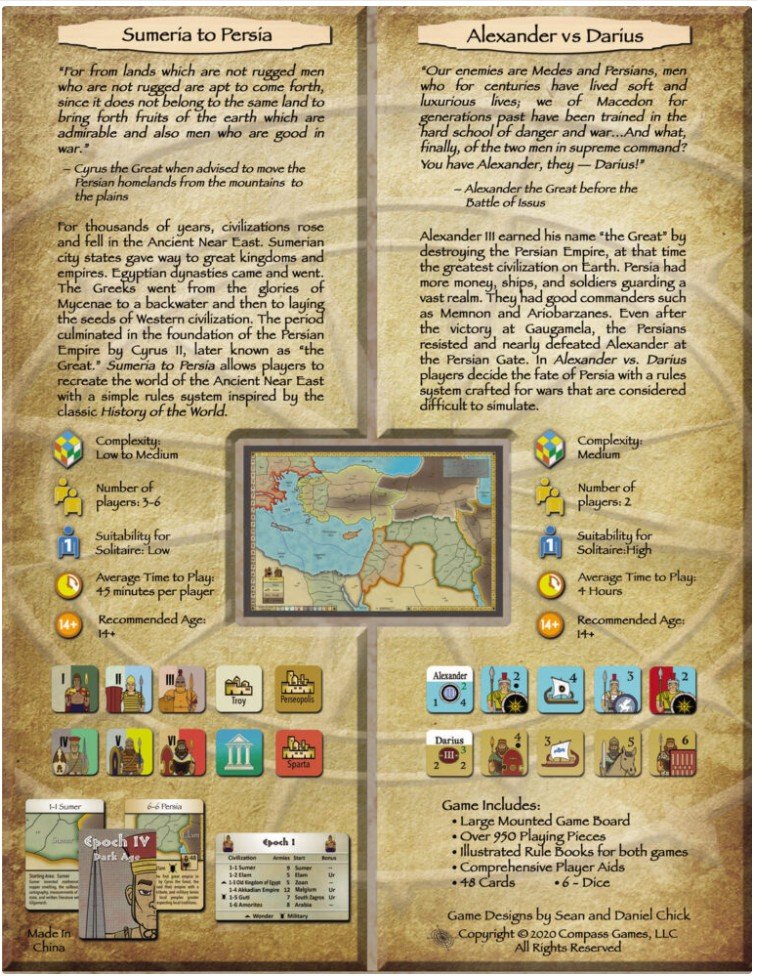 Image 2 of 2
Cradle of Civilization brings together two historical strategy games, Sumeria to Persia and Alexander vs. Darius, in one complete package. Covering the rise of the earliest civilisations in the Ancient Near East through to Alexander the Great's conquest of the Persian Empire, the games offer two different approaches to exploring the political, military and cultural developments of the ancient world.
In Sumeria to Persia, players guide successive civilisations through the Bronze and Iron Ages, building cities, expanding kingdoms and competing for influence as new empires emerge. From the early Sumerian city-states to the powerful Persian Empire established by Cyrus the Great, the game follows thousands of years of history while allowing events to unfold differently from their historical course.
Alexander vs. Darius shifts the focus to the struggle between Alexander III of Macedon and Darius III of Persia. Rather than treating Alexander's victory as inevitable, the game explores the strategic choices available to both sides and considers whether the Persian Empire could have survived through different military decisions and political circumstances.
Both games use accessible rules while offering different levels of strategic depth. With a large mounted board, substantial playing pieces and separate rulebooks, Cradle of Civilization provides two distinct experiences in a single box.
This game includes:
1 Large Mounted Game Board
Over 950 Playing Pieces
2 Illustrated Rulebooks (One for Each Game)
Comprehensive Player Aids
48 Cards
6 Dice
Key Features:
Two complete historical strategy games in one box
Covers the rise of ancient civilisations and the fall of the Persian Empire
Includes Sumeria to Persia, a multiplayer civilisation-building game
Includes Alexander vs. Darius, a two-player strategic wargame
Explore the development of city-states, kingdoms and great empires
Construct cities and wonders while competing for territorial influence
Historical civilisations can survive and continue expanding across successive periods
Random events introduce alternative historical possibilities
Experience the political and military consequences of the Bronze Age collapse
Recreate Alexander the Great's campaign against Darius III
War weariness and Persian legitimacy influence the outcome of the conflict
Explore alternative Persian strategies, including naval operations and the possibility of a Spartan rebellion
Accessible game systems with different complexity levels
Large mounted playing board and over 950 playing pieces
Suitable for both multiplayer competition and, particularly in Alexander vs. Darius, solitaire play
About the Game:
Cradle of Civilization explores two important periods in the history of the Ancient Near East, beginning with the emergence of organised civilisations and ending with the struggle that brought the Persian Empire under Macedonian control.
The two included games approach these events from different perspectives.
Sumeria to Persia concentrates on the long-term development of civilisations, where political influence, expansion and the changing fortunes of empires determine success.
Alexander vs. Darius focuses on a particular military conflict, challenging players to manage armies, political stability and strategic opportunities during Alexander's invasion of Persia.
Although both games share the same historical setting, each offers its own rules, objectives and decisions, giving players a choice between broad civilisation-building and a more focused military campaign.
Sumeria to Persia – The Rise of Ancient Civilisations
For thousands of years, the Ancient Near East witnessed the emergence of some of history's earliest and most influential civilisations. Small settlements developed into city-states, city-states became kingdoms, and powerful empires eventually came to dominate vast territories.
Sumeria to Persia follows this transformation through the Bronze and Iron Ages, culminating in the establishment of the Persian Empire under Cyrus the Great.
Designed for three to six players, the game uses a civilisation selection system inspired by History of the World. Players receive civilisations through cards, with additional choice available to those who are trailing in the competition.
As each civilisation enters play, players seek to expand their influence, establish cities and secure advantages that contribute towards victory.
Unlike games in which older civilisations simply disappear when a new period begins, surviving civilisations can remain active and continue expanding during later turns.
This creates opportunities for long-lasting kingdoms and empires, while also introducing challenges as new powers emerge.
Building Cities, Wonders and Empires
Players must consider more than military expansion when developing their civilisations.
The game includes rules for founding cities and constructing wonders, allowing players to strengthen their position through development as well as conquest.
Historical developments, including the Bronze Age collapse, influence the changing political landscape and can alter the fortunes of established powers.
Random events introduce further possibilities, sometimes allowing civilisations to achieve outcomes that were historically possible but never occurred.
The Minoans, for example, might benefit from an exceptional military commander, while Egypt could develop into a major seafaring power.
The Persian Empire eventually enters the game, but its considerable strength comes with an unusual balancing mechanism: the player selecting Persia must award Victory Points to opponents.
This encourages careful decisions about when to take control of a powerful civilisation and how to use its advantages.
With its relatively straightforward mechanics and changing historical situations, Sumeria to Persia offers an accessible way to experience the development of ancient empires.
Alexander vs. Darius – The Fall of the Persian Empire
The second game, Alexander vs. Darius, recreates Alexander the Great's campaign against the Persian Empire of Darius III.
When Alexander invaded Persia, he faced one of the wealthiest and most powerful empires in the ancient world. The Persians possessed extensive resources, a large military establishment and experienced commanders, including Memnon of Rhodes and Ariobarzanes.
Despite these advantages, Alexander's campaigns brought a succession of victories that ultimately destroyed Persian resistance and transformed the political landscape of the region.
Alexander vs. Darius challenges the assumption that this outcome was inevitable.
Designed for two players, the game allows one side to command Alexander's Macedonian forces while the other attempts to preserve the Persian Empire.
The Macedonian player must maintain military momentum and overcome Persian resistance, while the Persian player must find ways to delay, weaken and ultimately defeat the invading army.
Victory depends on more than battlefield strength, as political considerations and the growing strain of prolonged campaigning influence both sides.
War Weariness and Persian Resistance
A central feature of Alexander vs. Darius is its war weariness system, which represents the increasing pressure placed on Alexander's army as the campaign continues.
Historically, Alexander's soldiers eventually resisted further expansion during the invasion of India. In the game, however, setbacks and Persian victories may bring that point much earlier.
The Macedonian player must therefore balance continued military advances against the risk of exhausting the army's willingness to fight.
The Persian player has several strategic possibilities to explore.
One option is to follow the approach associated with Memnon of Rhodes, using Persian naval superiority to threaten Alexander's communications and rear areas rather than relying entirely on direct confrontation.
The game also considers the potential impact of a Spartan rebellion, which could place additional pressure on Macedonian interests elsewhere.
At the same time, Darius must protect his own political legitimacy. Failing to resist Alexander effectively may weaken his authority and threaten his position as ruler of the Persian Empire.
These competing pressures create a strategic contest in which both military operations and political decisions can influence the final result.
Two Different Ways to Explore Ancient History
One of the main attractions of Cradle of Civilization is the contrast between its two included games.
Sumeria to Persia offers a broader historical experience, allowing several players to guide civilisations through successive periods of expansion, decline and political change.
Alexander vs. Darius provides a more concentrated struggle between two opposing powers, with greater emphasis on military strategy, political stability and the consequences of prolonged warfare.
Both games are supported by a large mounted board, illustrated rules and substantial playing components, providing an accessible introduction to their respective historical periods.
Whether building the great empires of the Ancient Near East or attempting to change the outcome of Alexander's Persian campaign, players have the opportunity to explore how different decisions might have shaped ancient history.
Game Details:
Sumeria to Persia
Players: 3–6
Playing Time: Approximately 45 Minutes per Player
Complexity: Low to Medium (2/10)
Solitaire Suitability: Low (1/10)
Historical Period: Bronze Age to the Rise of the Persian Empire
Game Type: Civilisation-Building Strategy Game
Alexander vs. Darius
Players: 2
Playing Time: 4+ Hours
Complexity: Medium (4/10)
Solitaire Suitability: High (7/10)
Historical Period: Alexander the Great's Conquest of the Persian Empire
Game Type: Historical Strategic Wargame
NOTE: Cradle of Civilization includes two complete games in one box, both suitable for players aged 14 and over.
Cradle of Civilization combines the development of ancient empires with one of history's most significant military campaigns. From the emergence of Sumerian city-states to Alexander's struggle against Persia, the two games offer different perspectives on the ancient world, with accessible mechanics, historical detail and opportunities to explore alternative outcomes.